

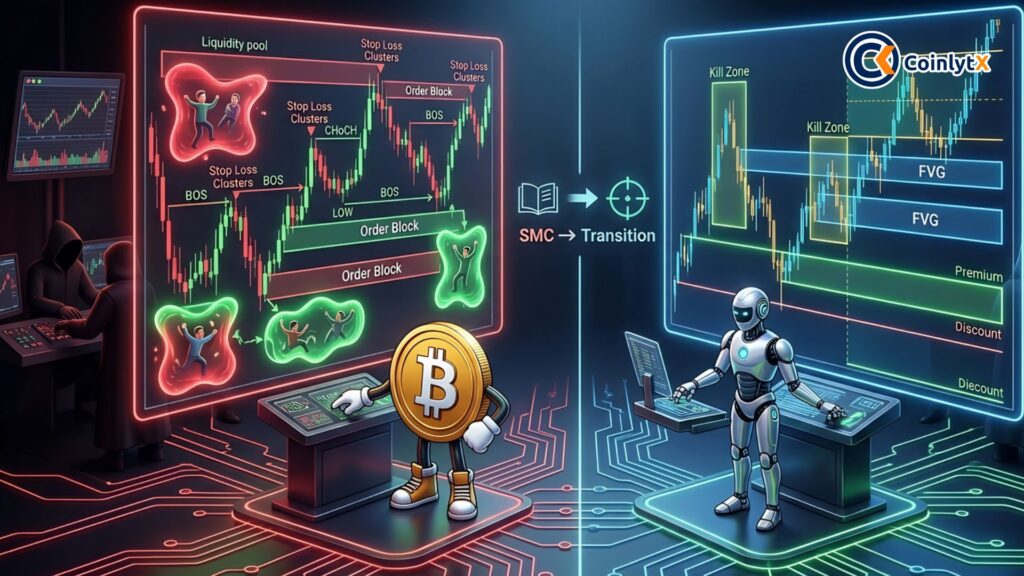
In today’s fast-moving financial markets, many traders are shifting from traditional indicators to smarter strategies like Smart Money Concepts (SMC) and ICT trading.
These approaches focus on understanding how big institutions move the market instead of relying only on indicators.
If you want to improve your trading skills in crypto, forex, or stocks, learning SMC and ICT can give you a strong edge.
Smart money and liquidity hunt
Smart Money Concepts, also known as SMC, is a trading approach that helps traders understand the behavior of institutional players such as banks and hedge funds.
The main idea behind SMC is that the market does not move randomly. Instead, it is driven by liquidity and large orders placed by smart money.
Retail traders often lose money because they follow lagging indicators, while institutions focus on liquidity zones.
What is liquidity in SMC ?
One of the most important parts of SMC is liquidity. Liquidity refers to areas where stop-loss orders are placed.
These are usually above highs or below lows. Institutions often push the market towards these zones to trigger stop losses and collect liquidity before making the real move.
Another key concept is Order Blocks, which are areas where institutions have previously placed large orders. These zones act as strong support or resistance levels.
Break of structure
Break of Structure (BOS) is another important SMC concept.
It helps traders identify whether the market trend is continuing or reversing.
If the market breaks a previous high or low, it signals a possible change in direction.
Fair value Gap
Fair Value Gap (FVG) is also widely used in SMC.
It represents an imbalance in price where the market tends to return before continuing its move.
What is ICT?
On the other hand, ICT (Inner Circle Trader) is a more advanced and structured trading method developed by Michael J. Huddleston.
ICT builds on the concepts of SMC but adds precise rules, timing, and entry techniques. It is designed to help traders execute trades with better accuracy.
One of the key features of ICT is the concept of Kill Zones. These are specific times during the trading day when the market is most active, such as the London session and New York session.
ICT traders focus on these periods to find high-probability setups. Another important idea is Liquidity Raids, where the market takes out stop-losses before reversing direction.
ICT also introduces the concept of Premium and Discount zones. This helps traders understand whether the price is expensive or cheap based on a range.
Traders aim to sell in premium zones and buy in discount zones. Another powerful tool in ICT is the Optimal Trade Entry (OTE), which uses Fibonacci levels to identify precise entry points.
SMC VS ICT
When comparing SMC and ICT, SMC is more like a foundation that teaches you how the market works, while ICT is a complete strategy with rules and execution methods.
Beginners should start with SMC to understand market structure and liquidity.
Once they are comfortable, they can move to ICT for advanced setups and better timing.
Conclusion
Both SMC and ICT trading strategies are powerful tools for modern traders. They shift your mindset from guessing the market to understanding how it truly moves. By learning these concepts, you can improve your accuracy, manage risk better, and trade with confidence. If you are serious about trading in 2026, mastering SMC and ICT can be a game-changer for your journey.