
Recalling Satoshi Nakamoto’s Last Public Moment 15 Years Later
Key Insights
01
Quick Takeaways: December 13, 2025, marks fifteen years since Satoshi Nakamoto was last publicly active.
02
The instant endures via a forum entry accessed globally.
03
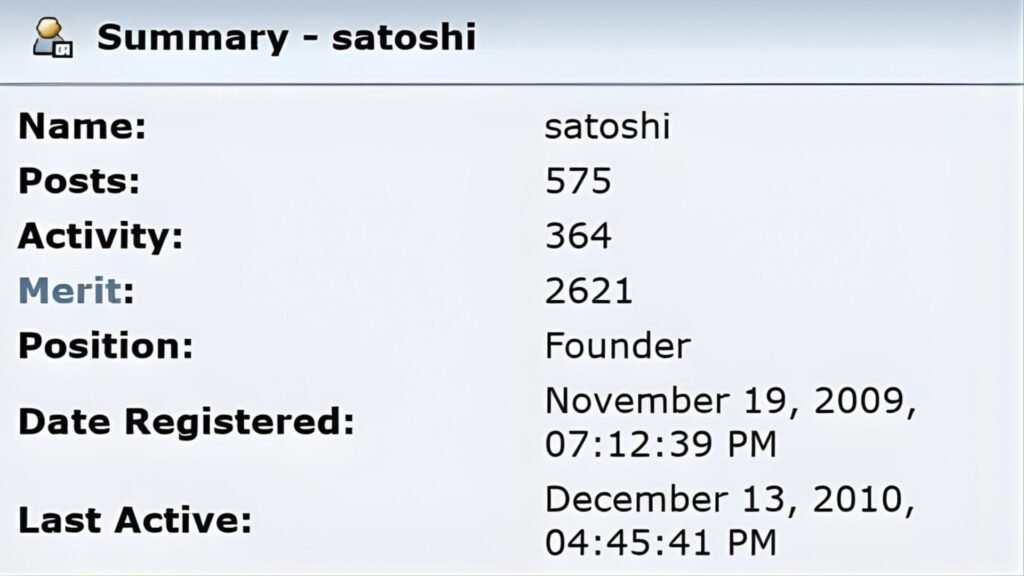
Satoshi’s account indicates an access on December 13, 2010 at 4:45 PM.
Quick Takeaways:
- December 13 marks 15 years since Satoshi Nakamoto’s last public activity.
- Bitcoin has evolved from a trial into an international financial system.
- Satoshi’s absence reinforced decentralization and shaped crypto culture.
December 13, 2025, marks fifteen years since Satoshi Nakamoto was last publicly active. The instant endures via a forum entry accessed globally.
Satoshi’s account indicates an access on December 13, 2010 at 4:45 PM.
There was no announcement, farewell, or explanation attached to the moment.
Then, Bitcoin was still a minor open-source endeavor.
Hardly anyone could foresee the system evolving into a cornerstone of finance.
That silent sign-off concluded one of the most significant public careers in tech.
It also launched one of the greatest mysteries in modern history.
An Originator Who Opted for Vanishing
Satoshi’s public presence was minimal yet intentional.
They contributed 575 posts to the forum. Accumulated 364 activity points.
Their designation was straightforward: Founder.
There was never any biography, image, or confirmable identity presented.
Following the publication of the Bitcoin whitepaper, Satoshi oversaw the development.
They debated scaling, security, and incentives with early contributors.
Their final known message suggested Bitcoin was “in good hands.”
Shortly after, all communication stopped. This departure transferred full responsibility to the community.
Bitcoin no longer had a visible leader or central authority. Many believe this decision was intentional. It removed personal influence from the protocol’s future.
Bitcoin’s Evolution Without Its Creator
What followed reshaped technology, economics, and finance.
Bitcoin evolved from a forum experiment into a global settlement network.
It survived early hacks, exchange failures, and internal disputes.
Each challenge tested the system’s resilience and social consensus.
Today, Bitcoin interacts with governments, corporations, and institutions.
Public companies hold it as a treasury asset.
Financial products now track their price and liquidity.
Entire industries formed around mining, custody, and infrastructure.
None of this required Satoshi’s return. The protocol continued to operate as designed. Developers proposed upgrades through open debate.
Miners and node operators enforced rules through consensus.
Bitcoin’s growth proved the strength of decentralized coordination.
The network did not need its creator to survive.
Why Satoshi’s Absence Became a Strength
Satoshi’s silence shaped Bitcoin’s identity more than any public appearance.
There is no founder influence over monetary policy or governance authority that can claim special privileges, nor can a control figure be pressured by governments or markets.
This absence protects Bitcoin’s neutrality. Rules apply equally to all participants. It also prevents reputational risk.
Bitcoin cannot be tied to personal scandals or political views.
Many projects struggle when founders dominate direction.
Bitcoin avoided that problem from the start. The mythology surrounding Satoshi grew with time. Speculation persists, but certainty never arrives.
That uncertainty reinforces Bitcoin’s message. The system matters more than the individual behind it.
A Screenshot That Still Resonates
The image circulating today appears simple. It shows Satoshi’s registration date of November 19, 2009.
It also displays the last activity in December 2010. That single screenshot carries immense symbolic weight. It reminds users how briefly Satoshi participated. Yet those contributions sparked a global movement.
Bitcoin’s design invited others to take over. Millions now maintain, secure, and use the network. Fifteen years later, Bitcoin continues without guidance from its creator.
The protocol adapts through collective decision-making.
Satoshi’s disappearance became part of the architecture.
Decentralization was not just technical, but social. As crypto markets mature, this lesson remains relevant. Systems last when they outgrow their founders.
Satoshi Nakamoto left quietly. The impact continues to echo across the world.