

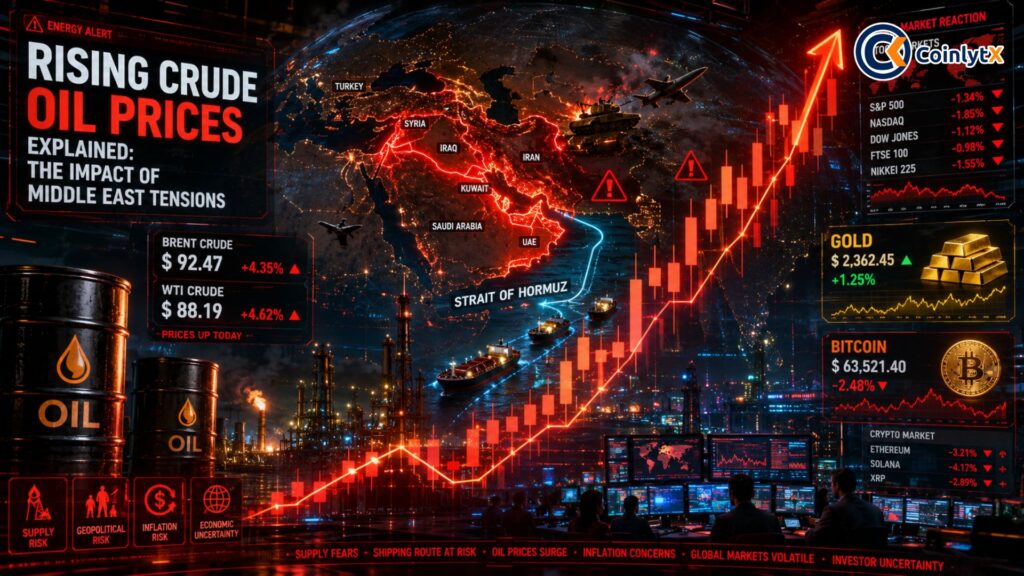
Global crude oil prices are rising once again as tensions in the Middle East create uncertainty across financial markets. Investors, governments, and businesses are closely watching the region because the Middle East plays a major role in global energy supply. Any conflict or military escalation in this area can quickly affect oil production, transportation routes, inflation, stock markets, and even cryptocurrency prices.
The recent increase in regional tensions has pushed benchmark crude oil prices higher due to fears of supply disruption. Markets are reacting strongly because oil remains one of the most important commodities for the global economy.
Oil Supply Fears Are Driving Prices Higher
One of the biggest reasons behind rising crude oil prices is fear about global oil supply. Countries in the Middle East produce a significant share of the world’s crude oil exports. If conflicts expand or important oil infrastructure gets affected, global supply could tighten rapidly.
Higher oil prices also affect transportation, manufacturing, and electricity costs worldwide, making energy inflation a major concern again.
Why the Strait of Hormuz Matters So Much
The Strait of Hormuz is one of the world’s most important oil shipping routes. Nearly one-fifth of global oil supply passes through this narrow waterway every day. Countries such as Saudi Arabia, Iraq, Kuwait, and the UAE rely heavily on this route to export oil to international markets.
If tensions in the Middle East threaten shipping activity near the Strait of Hormuz, global markets react immediately. Investors fear delays, higher shipping costs, or even temporary supply blockages.
Inflation Risks Are Rising Again
Rising crude oil prices can directly increase inflation globally. When fuel prices rise, transportation and production costs also increase. Businesses often pass these extra costs on to consumers, making goods and services more expensive.
Central banks like the US Federal Reserve closely monitor oil-driven inflation because higher inflation can delay interest rate cuts. If rates stay high for longer, borrowing becomes more expensive for businesses and consumers.
Stock Markets, Gold, and Crypto React to Uncertainty
Global stock markets usually react negatively when geopolitical tensions rise. Investors become cautious about future economic growth and corporate earnings. Energy stocks may benefit from higher oil prices, but many sectors such as airlines, manufacturing, and consumer businesses often face pressure.
The cryptocurrency market has also become sensitive to global geopolitical events. Bitcoin and other digital assets recently experienced sharp volatility as traders moved away from risky investments during market uncertainty.
Fuel Price Pressure Could Hurt Consumers
Higher crude oil prices can eventually lead to rising petrol and diesel prices in many countries. This directly affects household budgets, transportation costs, and overall spending power.
Developing economies may face additional pressure because expensive fuel increases import bills and weakens economic stability. Governments may also struggle to control inflation if oil prices remain elevated for a long period.
Growing Fears of a Global Economic Slowdown
Many analysts believe prolonged Middle East tensions could slow global economic growth. High oil prices, inflation pressure, and uncertain financial conditions may reduce consumer spending and business investment worldwide.