

Important Highlights
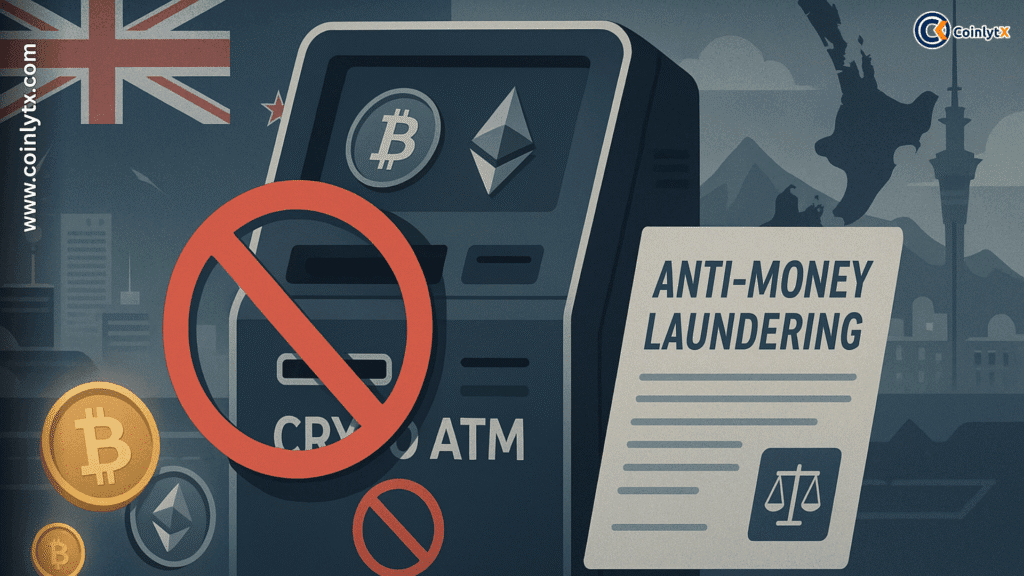
- The New Zealand government is looking to put a stop to crypto ATMs as part of their efforts to combat money laundering.
- It also wants to limit international cash transfers to $5,000 NZD.
- The new law would give more power to police and regulators to catch financial criminals.
A Crypto ATM Ban? Here’s What’s Going On
New Zealand is planning a major crackdown on how crypto works in the country — and it all starts with a proposed crypto ATM ban.
If you’ve ever used one of these machines, you probably know how convenient they can be.
You just walk up, insert some cash, and get crypto sent straight to your digital wallet. No bank, no middleman.
But here’s the thing: that same convenience has made crypto ATMs a go-to tool for scammers and money launderers.
According to the government, criminals are using them to move cash into the digital world where it’s a lot harder to track.
So now, officials want to take those machines offline for good.
“They’re Turning Cash Into Risky Assets”
When Associate Justice Minister Nicole McKee made the announcement this week, she stated as much.
She explained that these machines are helping people “convert cash to high-risk assets such as cryptocurrencies”, which sounds harmless until you realize that’s often code for criminal activity.
Think of it like this: someone advertises a secondhand car online.
You agree to buy it, and they tell you to pay using a crypto ATM.
The car never comes, even though you send the money.
The seller vanishes. Your money? Gone.
This kind of thing happens more than most people realize and because of that, the government’s stepping in.
Also on the Table: Limits on Sending Cash Overseas
But the crypto ATM ban isn’t the only change being proposed.
The government also wants to put a cap on international cash transfers.
Under the new plan, you wouldn’t be able to send more than NZ$5,000 (around US$3,000) in cash overseas at one time.
Why? Because large, anonymous transfers are a red flag for money laundering.
If you’re running a legit business or helping family abroad, there are still legal ways to do that but the idea is to make shady transactions a lot harder.
Giving the Police More Tools to Do Their Job
These proposals are part of a bigger overhaul of New Zealand’s anti-money laundering (AML) rules.
And that includes making life easier for law enforcement.
A new bill has been introduced that would give the police and financial watchdogs stronger powers to investigate and shut down financial crime.
According to McKee, the goal is to simplify the system both for those fighting crime and for businesses trying to follow the rules.
Therefore, it goes beyond simply outlawing things.
It also involves developing a system that is transparent, equitable, and more difficult to exploit.
Other Countries Are Already Doing This
If this all sounds like a big deal it is. But New Zealand isn’t alone here.
Other countries have been tightening the reins on crypto for years.
Beyond Tasman, Australia has already introduced strict rules around Crypto ATMs and exchanges.
Do you know that there are more than 38,000 crypto ATMs worldwide, of which more than 30,000 are in the United States?
Even though most users are perfectly valid, it only takes some wicked actors to cause severe damage.
Therefore, even though some users find it disappointing,
New Zealand’s move makes sense in that context.
So what does this mean for you?
If you’re someone who casually uses crypto, this probably won’t flip your world upside down.
You’ll still be able to buy, sell, and transfer digital assets through regulated online platforms.
But if you rely on crypto ATMs because you don’t have access to a traditional bank
or you just prefer using cash this could definitely change how you operate.
You may need to explore other ways to access crypto safely and legally.
And for businesses in the space? You’ll need to keep a close eye on how these laws evolve.
Because the government says that the goal is “clarity and stability”, yet it will take time to adjust everyone.