

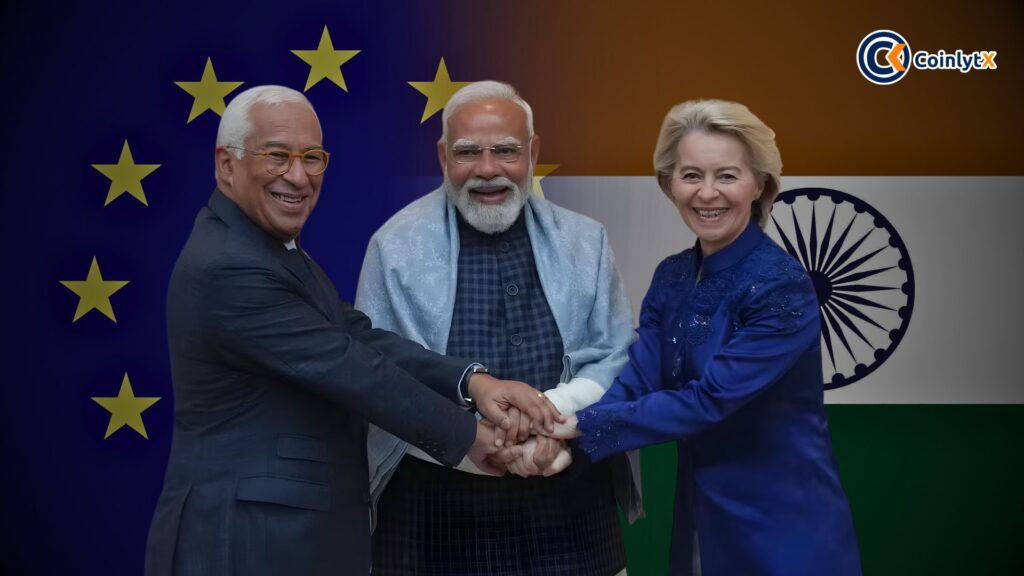
- India and EU have signed a trade deal that has unlocked a $27 trillion market covering two billion people, nearly 25 percent of global GDP.
- The pact cuts tariffs on cars, textiles, chemicals, and services, in a bid to boost supply chains and investment flows in both regions.
- US tariff pressure was the main accelerator of the India-EU alignment as both seek a haven to escape away from American trade dependence.
The recently signed India EU trade deal has created a $27 trillion market. Both nations are seeking to reshape global commerce from the ongoing geopolitical and tariff uncertainty.
After close to two decades of talks tariff cuts, services access, and investment protections both sides have finalized the agreement and are strategically converged.
This was prompted by the need for an hedge for India and Europe products against US trade volatility and protectionist pressures.
A Landmark Trade Pact Reshapes Global Economics
According to a report by Aljazeera, India and the European Union finalized commercial pact covers goods, services, and cross-border investments. The agreement links 27 EU nations with India.
This forms a free-trade zone that represents nearly 25 percent of global GDP. Leaders described the pact as transformational,and one that will improve market certainty during the intensifying global trade disruptions.
Negotiators added that the cause for accelerated talks was due to the rise in US tariffs, supply chain fragmentation, and the growing geopolitical competition.
To back it up, European Commission President Ursula von der Leyen termed the agreement as historic. To echo on that , Indian Prime Minister Narendra Modi also praised it for its manufacturing gains on both players.
The deal restored momentum between EU trade preferences for India. For now, exporters have regained access to trade textiles, pharmaceuticals, machinery, and industrial goods.
Analysts projections expect that trade volumes could reach $200 billion annually by 2030.
This underscores the economic interdependence as both economies absorb U.S tarrif policy shocks.
Tariff Cuts Open Autos, Services, and Industrial Trade
As a part of the deal, India agreed agreed to gradually lower steep automobile tariffs. This concesus addressed a long-standing European concern.
As a result, duties on most EU cars will be lowered towards 10 percent over the next several years. Lower rates will help safeguard domestic manufacturers.
Initially, Electric vehicle imports remained protected which allowed Indian firms time to scale local production. Meanwhile, Europe eliminated tariffs on up to 93 percent of Indian goods within seven years.
Seafood, chemicals, textiles, leather, and gems gainned immediate zero-duty access to EU markets. Services liberalization was also advanced. Europe openned 144 new subsectors to Indian firms.
India reciprocated this gesture by granting access across finance, maritime logistics, and telecommunications. Both sides are simplifying customs procedures, to strengthen intellectual property rules, and reduce regulatory friction.
Consequently, businesses have gainned predictability across complex EU compliance frameworks.
Strategic Realignment Amid US Trade Pressures
The agreement lands as Washington intensifies tariff pressure on both partners. The United States has maintained elevated duties on Indian goods over Russian oil purchases.
Europes lingering US tariffs and political disputes, have been caused by tensions involving the Greenland. Geopolitical pressures pushed India and the EU to seek deeper strategic coordination.
Trade economists described the pact as a diversification strategy and not an outright decoupling. Therefore, through this broadening of their partnerships, both sides will reduce their exposure to American policies.
Most US officials have come out to publicly criticize the agreement, arguing that it undermines sanctions objectives. In spite, European and Indian leaders have termed the deal as a pragmatic economic stabilization.
They have expressed optimism that over time, this alignment will reshape global trade architecture beyond traditional US-centric frameworks.