
Quick Takeaways
- Vitalik Buterin says Ethereum has effectively solved the blockchain trilemma using ZK-EVMs and PeerDAS.
- He claims the technology works in live code and supports massive data throughput while staying decentralized.
- Full security hardening will take years, with core validation changes expected between 2027 and 2030.
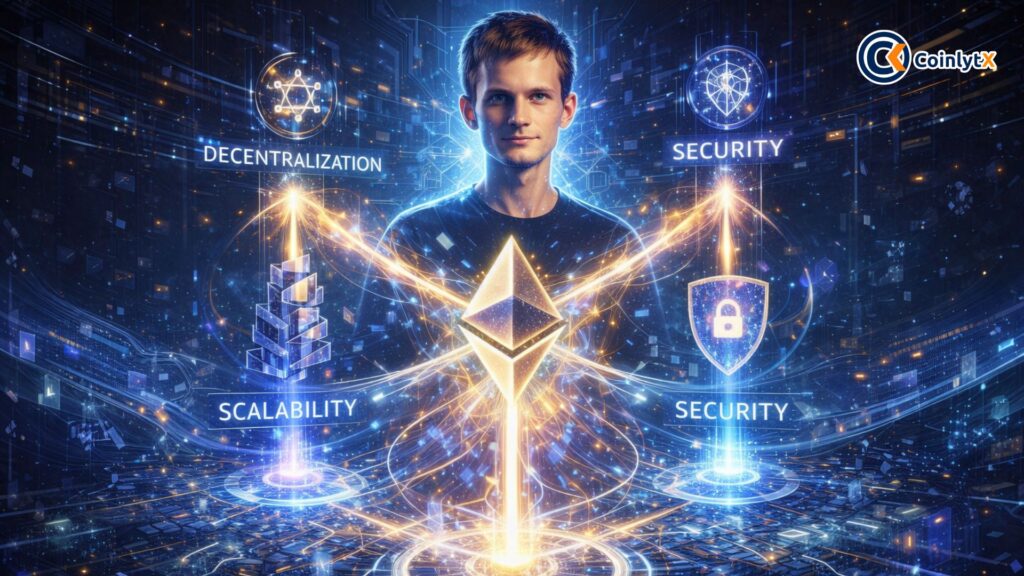
Ethereum co-founder Vitalik Buterin says the electronic network has crossed a historic milestone. He claims Ethereum has effectively solved the blockchain trilemma problem. The trilemma refers to the challenge of accomplishing scalability, security measures, and decentralization together. Blockchains have historically optimized only two at the expense of the third.
In a Jan. 3 post on X, Buterin said Ethereum’s architecture has fundamentally changed. He leads live deployments of novel privacy and information-handling technologies. “These are not theoretical breakthroughs, ” Buterin said. “They are working today in existing product environments. ”
ZK-EVMs and PeerDAS Drive the Shift
Buterin credited two major innovations for the breakthrough. The first is the integration of zero-knowledge Ethereum Virtual Machines, or ZK-EVMs. ZK-EVMs allow transactions to be validated cheaply without revealing underlying data. They compress computation while preserving Ethereum’s security guarantees.
The second pillar is PeerDAS, a data availability sampling method. PeerDAS lets the network distribute and verify massive data loads efficiently. Together, these systems allow Ethereum to scale without centralizing power. Buterin described the result as “a BitTorrent with consensus.”
Unlike Bitcoin, which prioritizes minimal data throughput, Ethereum now handles scale. It can support rollups and applications with far higher bandwidth demands.
Why Buterin Says the Trilemma Is Solved
Buterin argued the trilemma is no longer an abstract theory. He said Ethereum has solved it by running code, not whitepapers. “Data availability sampling is already live on mainnet,” he wrote. “ZK-EVMs are production-quality on performance today.”
This means Ethereum can process huge volumes of data. It does so while maintaining decentralized validation. The shift enables rollups to scale without overloading base-layer nodes. That keeps participation accessible for smaller operators.
Buterin stressed that scalability no longer requires sacrificing decentralization. In his view, Ethereum has crossed that engineering barrier. However, he cautioned that security remains the final piece. Hardening these systems will take time and careful execution.
Security Timeline Extends Toward 2030
While performance is ready, Buterin said safety work is ongoing. He does not expect ZK-EVMs to fully validate blocks until later. According to his roadmap, that transition could happen between 2027 and 2030. Until then, Ethereum will rely on incremental improvements.
In the near term, the network plans to raise the gas limit. This will increase transaction capacity without compromising stability. Protocol changes will separate transaction proposers from block builders. This allows each block to handle more work efficiently.
Looking further ahead, Buterin outlined a vision for distributed block building. In this model, no single actor constructs an entire block. Instead, block production becomes shared across participants. This reduces censorship risks and regional concentration.
“The full block should never exist in one place,” Buterin wrote. He called it a long-term goal worth pursuing.
Competition Raises the Stakes for Ethereum
Ethereum’s roadmap arrives amid intense competition. Rival blockchains continue to market faster speeds and lower fees. Networks like Solana and others attract users with simpler architectures. This pressure has pushed Ethereum to accelerate scaling solutions.
Buterin acknowledged that expectations are rising. Developers and users want results, not promises. The ZK-EVM and data upgrades aim to secure Ethereum’s lead. They allow the network to scale without abandoning core principles.
If successful, Ethereum could support global-scale applications. That includes finance, gaming, identity, and AI-linked workloads. Still, execution risk remains. The next several years will test Ethereum’s governance and engineering discipline.
For now, Buterin believes the hardest problem is solved. The remaining challenge is making it safe, resilient, and permanent.