
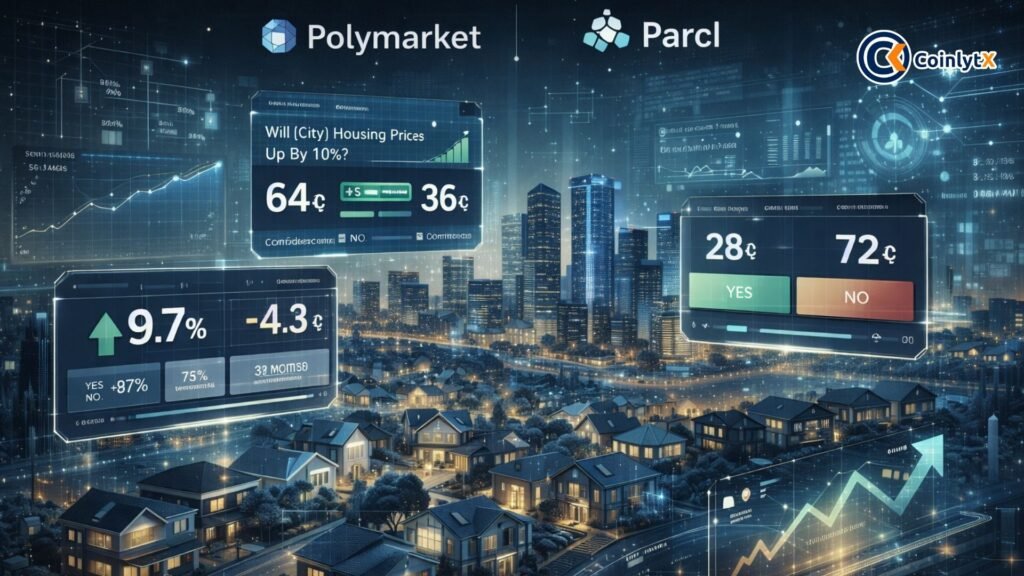
Polymarket Launches New Housing Price Prediction Markets via Parcl Alliance
Key Insights
01
Quick Takeaways Polymarket is expanding its prediction market offerings into real estate, marking a new phase in the financialization of housing data.
02
The Polygon-based platform announced a partnership with on-chain real estate data provider Parcl to launch housing price prediction markets.
03
The integration will allow users to trade outcomes tied to city-level home price movements.
Quick Takeaways
- Polymarket will launch housing-focused prediction markets using Parcl’s real estate indices.
- Traders can speculate on whether city home prices rise or fall over set time periods.
- The move expands prediction markets into real estate price discovery and hedging use cases.
Polymarket is expanding its prediction market offerings into real estate, marking a new phase in the financialization of housing data.
The Polygon-based platform announced a partnership with on-chain real estate data provider Parcl to launch housing price prediction markets. The integration will allow users to trade outcomes tied to city-level home price movements.
The new markets will initially focus on major U.S. housing markets. Expansion will occur in phases based on user demand.
Turning Housing Data Into Tradable Markets
Under the partnership, Parcl will provide daily housing price indices to Polymarket. These indices will act as the settlement reference for prediction markets.
Users will be able to trade on whether a city’s housing price index finishes higher or lower over a month, quarter, or year. Other markets may settle on threshold-based outcomes using predefined price levels.
Polymarket said the curated markets aim to offer a simpler way to trade housing outcomes. The platform positions the product as data-driven and objectively verifiable.
The settlement process relies on Parcl’s published indices, which serve as a neutral source of truth. This structure reduces disputes and improves transparency.
Why Polymarket Chose Parcl
Prediction markets depend on clean, verifiable data. Polymarket executives say Parcl’s daily indices meet that requirement. “Prediction markets work best when the data is clear, and outcomes are verifiable,” Polymarket CMO Matthew Modabber said.
He added that Parcl’s indices provide a strong foundation for transparent market resolution. Parcl Labs launched during the COVID-19 pandemic. The company builds housing price indices using public property records, county data, verified sales, and other sources.
According to Parcl’s documentation, its price feed offers daily estimates of residential real estate prices per square foot across multiple markets. The data spans sales, listings, rentals, supply trends, and new construction.
How the Housing Prediction Markets Work
Polymarket plans to introduce standardized market templates for housing outcomes. These templates will define terms, resolution dates, and settlement mechanics. Questions may ask whether a city’s home price index closes higher or lower over a specific period. Other contracts may resolve once a price threshold is crossed.
The markets will initially focus on high-liquidity cities. This approach aims to ensure tighter spreads and better price discovery. By using standardized formats, Polymarket expects faster market creation and improved user understanding.
In theory, these markets could also serve as hedging tools. Homebuyers, developers, and investors may use predictions to manage exposure to local price movements.
Expanding Prediction Markets Beyond Politics
Polymarket has rapidly expanded its market offerings over the past year. The platform gained attention for political forecasting but has since diversified. Recent growth has come from sports, macroeconomic indicators, and now real estate. The Parcl integration reflects a broader push into real-world financial data.
The platform’s U.S. relaunch also contributed to increased activity. Polymarket now launches new markets monthly across multiple categories. Despite growing competition, Polymarket remains one of the most active prediction platforms. It is often compared to rival Kalshi, though both face emerging challenges.
The real estate expansion positions Polymarket at the intersection of crypto, data markets, and traditional finance.
The Broader Implications for Real Estate Markets
The launch raises questions about the further financialization of housing. Critics may argue that turning home prices into speculative instruments adds volatility. Supporters counter that prediction markets improve transparency. They aggregate expectations into prices that reflect collective forecasts.
Housing markets have long suffered from delayed and fragmented data. Daily on-chain indices could shorten feedback loops. If adopted widely, prediction markets may influence how investors and policymakers interpret housing trends.
For Polymarket, the move underscores its ambition to become a global forecasting layer for real-world outcomes. As blockchain-based data platforms mature, housing may become one of many asset classes reshaped by on-chain prediction markets.