
- KOSPI All-Time High record is driven by 134% YoY semiconductor export growth and strong AI-linked earnings.
- Retail capital shifted from crypto markets to Kimchi Premium narrows, and accelerated equity inflows.
- Record margin loans and an elevated volatility index signal potential short-term correction risks.
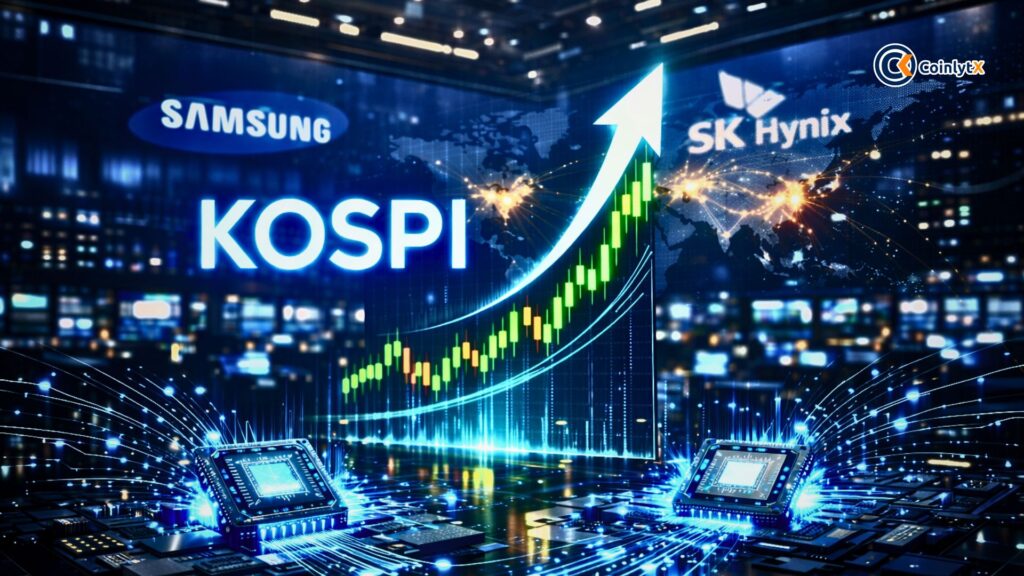
KOSPI South Korea’s benchmark index closed at 6,307.27, up 3.67%, adding to its record run on Feb. 26, 2026. Strong gains by Samsung Electronics and SK Hynix accounted for the push that strengthened the Korean won to a one‑month high against the U.S. dollar.
Semiconductor Surge Drives KOSPI All-Time High
The KOSPI All-Time High reflects a structurally concentrated rally centered on semiconductor leaders. Samsung Electronics and SK Hynix are accountable for a large share of index performance.
Shares of both companies jumped more than 7% after strong AI-linked quarterly earnings from Nvidia, a bellwether for global AI demand.
NVIDIA reported $62.3 billion in fourth-quarter data center revenue, and Korean chipmakers benefited directly from rising memory demand.
Export data reinforced the rally. Early February figures showed daily average exports rising 47% year-over-year. Semiconductor shipments surged 134%, accounting for over one-third of total exports.
High-bandwidth memory chips remain central to AI server deployment. As hyperscalers expand infrastructure, demand flows directly into Korean semiconductor revenues.
Retail Rotation and the Fading Kimchi Premium
The KOSPI All-Time High coincides with shifting domestic capital flows. South Korea has long been known for active crypto retail participation.
During prior bull cycles, Bitcoin traded at higher prices on Korean exchanges. This pricing gap became known as the Kimchi Premium.
Recent months show that the premium is narrowing sharply. Since the October crypto downturn, retail funds appear to be rotating toward equities.
Market participants referenced this shift widely on social platform X, noting the compression of the Kimchi Premium. Posts described retail traders reallocating into AI and semiconductor stocks.
Individual investors purchased a net 1.14 trillion won in shares during Thursday’s rally. In addition, institutional investors added 1.02 trillion won, even as foreign investors sold 2.39 trillion won.
As a result, retail leverage and margin loans have hit 32.13 trillion won, up 18% since the start of the year.
Valuations, Volatility, and Policy Backdrop
Japan’s Nikkei 225 trades near 24 times forward earnings. Taiwan’s TAIEX stands at around 24.8 times, while Hong Kong’s Hang Seng Index trades at around 13 times.
President Lee Jae Myung addressed the rally, referring to a transition from a “Korea discount” toward a “Korea premium.” He described the market’s move as normalization.
However, volatility indicators signal caution. The Kospi Volatility Index climbed above 54, a level often associated with elevated fear.
Analysts project tight chip supply could persist through 2028 as AI expands into video applications. Robotics stocks also advanced after Nvidia cited the adoption of its AI platform by industrial users.
The junior Kosdaq index gained nearly 2% on the day. Policy measures aim to strengthen that market through benchmark reforms and stricter delisting rules.