

Quick Takeaways:
- Lebanese Prime Minister Nawaf Salam said that the military activities of Hezbollah are against the law. This happened after they attacked Israel.
- Israel did something back. They had airstrikes on the suburbs of Beirut At 52 people died because of this.
- Hezbollah did not agree with the decision of the government. Hezbollah thinks the government should not have banned its activities.
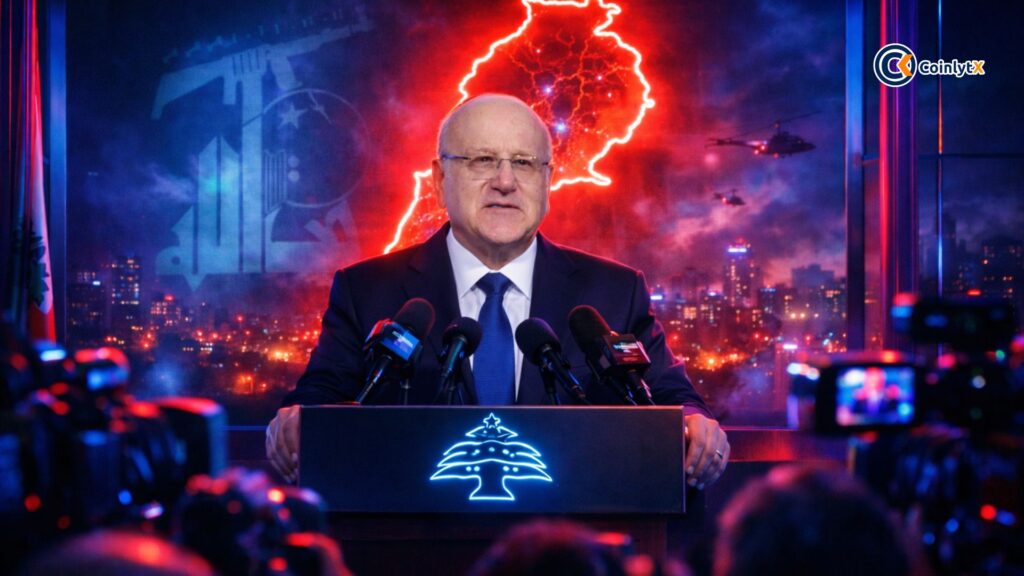
The Prime Minister of Lebanon, Nawaf Sala has stopped Hezbollah from doing military and security work. This happened after there was a fight across the border with Israel. They fought back right away.
Nawaf Salam said that all of Hezbollah’s work is now against the law in Lebanon. He said Hezbollah can only work from now on. “Nawaf Salam” said, We do not want any military or security work to happen outside of the channels”.
He told the security people to make sure no more attacks happen from Lebanon. This is one of the things the Lebanese Government has said against Hezbollah for a long time.
It is happening when there are more problems in the region, and other countries are putting a lot of pressure on them. The Lebanese Government and Nawaf Salam are taking a step by saying Hezbollah’s military activities are illegal. Hezbollah’s military activities are no longer allowed in Lebanon.
Israel is fighting back with airstrikes on Beirut and Southern Lebanon.
The trouble started when Hezbollah sent rockets and drones towards Israel. Hezbollah said they were aiming at a place near Haifa where Israel keeps its missile defense system.
Hezbollah did this because they were angry about the death of the Supreme Leader. They think they are protecting Lebanon from Israel’s attacks.
Israel hit back with airstrikes on the part of Beirut at night. The government in Lebanon says that 52 people were killed and 154 were hurt.
Israel’s military says they killed a man named Hussein Makled in one of their airstrikes. Hussein Makled was in charge of Hezbollah’s intelligence headquarters.
Israel says Hussein Makled was planning attacks and gathering information to use against forces. The military says it will keep going after Hezbollah.
Hezbollah Refuses to Back Blames Government for Being Too Weak
Hezbollah thinks the government’s move is unfair. The group says the authorities are not strong enough to deal with Israel.
“We don’t think it’s right to take action against Lebanese people who don’t want Israel around, ” Hezbollah said.
They agree that the government gets to make decisions about war. They don’t like the timing.
Hezbollah does its thing separately from the Lebanese government. Its military has been working on its own for a time.
The group lost a lot during the 2024 fight with Israel. Israel got rid of some of Hezbollah’s leaders, both military and political.
With those losses, Hezbollah still has a lot of influence in southern Lebanon and the suburbs of Beirut. The question of whether Hezbollah should give up its weapons is still an issue.
Disarmament Plans and Growing International Pressure
Lebanon agreed in principle to disarm Hezbollah under external pressure. The United States and Israel have strongly supported this effort.
Hezbollah rejected full disarmament north of the Litani River. It argued that a November 2024 ceasefire applied only to southern zones.
Lebanon’s military completed the first phase of a five-stage disarmament plan in January. That phase covered territory between the southern border and the Litani River.
Authorities estimate the second phase will require at least four months. It focuses on areas between the Litani and Awali rivers.
Implementation remains complex amid ongoing hostilities. Political divisions inside Lebanon complicate enforcement.
Humanitarian Concerns Deepen as Crisis Expands
The renewed military exchange threatens to worsen Lebanon’s fragile stability. The country already faces economic collapse and political paralysis.
Israeli forces ordered evacuations in 18 Lebanese towns. Officials claimed those areas housed Hezbollah operations.
Thousands have fled southern Lebanon and Beirut’s southern suburbs. Observers warn of a developing humanitarian emergency.
Local reporters describe large-scale displacement and rising fear. Aid organizations are monitoring the situation closely.
The United States embassy in Beirut urged Americans to leave immediately. Officials described the security environment as volatile and unpredictable.
Regional Risks and Political Implications
The Hezbollah military ban in Lebanon shows that the state is under a lot of pressure. It’s still not clear if the ban will be enforced.
Hezbollah has politicians in the parliament. They also have a social and security presence in many communities.
The Prime Minister, Salam, said the initial attack was reckless and risky. He thinks it gives Israel a reason to attack again.
Israel seems to want to weaken Hezbollah’s power. There might be military actions in the next few days.
This crisis could change how power works in Lebanon. It could also affect the balance of power in the region.
People in the market and policymakers are watching closely. If things get worse, it could cause problems in the Mediterranean.
Now Lebanon is at a turning point. The state authority is up against the power of groups, and there’s also conflict from outside.
It’s still unclear if the Hezbollah military ban in Lebanon will be enforced. The next few weeks will show if the politicians are strong and if the region can stay stable.