

Quick Takeaways
- The EU’s approval of its US business deal accompanies Trump’s Greenland tariff threats.
- European officials sign readiness to deploy the axis’s brawny “trade bazooka. ”
- Escalating trade tensions could impact $1.5 trillion in annual transatlantic commerce.
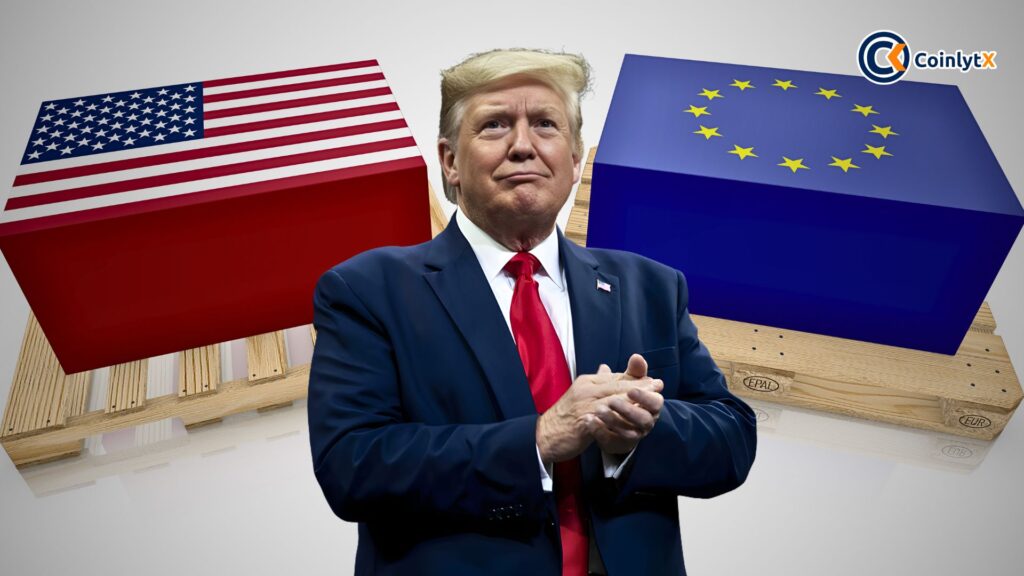
The European Union has paused work on approving its trade accord with the United States. The relocation follows threats of smart tariffs from Donald Trump, linked to Greenland.
Bernd Lange, chairman of the European Parliament’s trade commission, announced the decision on Wednesday. He supposes escalating atmospheric pressure left the EU with no alternative.
Language discourages the idea that the reign and territorial integrity were at stake. His cooperation was impossible under threats.
Greenland Tariffs Trigger Diplomatic Shock
The suspension follows Trump’s statement that tariffs would hit European countries. He warned of penalties unless the US advances control over Greenland.
Greenland is a sovereign territory within Denmark. Its strategic Gelid spot has drawn renewed geopolitical attention.
Trump later said force would not be used. However, he maintains potential tariffs on the table.
European officials viewed the comments as coercive. The response marked a sharp shift from summer optimism.
What the Turnberry Deal Promised
The trade deal was finalized last July in Scotland. It followed talks between Trump and Ursula von der Leyen.
At its core, the concord crest most US duties on EU goods at 15%. Some sectors, including generic pharmaceuticals, would have seen tariffs eliminated.
In return, the EU planned to reduce duties on US agricultural and industrial goods. The goal was mutual market access and stability.
The European Commission initially praised the deal. Officials said it restored predictability in trade relations.
A $1.5 Trillion Relationship at Risk
The US and EU share the world’s largest trade relationship. Annual trade in goods and services totals roughly $1.5 trillion.
The US imports more than $600 billion in EU goods each year. Europe buys over $360 billion in American products.
Suspending the deal threatens that balance. Businesses on both sides face renewed uncertainty.
Von der Leyen underscored the stakes at Davos. She said deals must mean something between partners.
Europe Signals Readiness to Retaliate
EU leaders are now weighing coordinated countermeasures. Discussions include tariffs worth nearly $110 billion.
Potential targets range from Boeing aircraft to soybeans. American bourbon could also face duties.
More dramatically, officials are considering the “Anti-Coercion Instrument.” The policy is often called the EU’s trade “bazooka.”
What the Trade ‘Bazooka’ Means
The Anti-Coercion Instrument allows sweeping retaliation. It can target goods, services, and investment flows.
Possible measures include license suspensions and IP restrictions. Market access bans are also on the table.
The tool was designed to counter economic coercion. It has never been used before.
Lange openly backed its deployment. He said Trump’s tactics crossed a new line.
Markets Watch for Spillover Effects
Trade tensions frequently spill into financial markets. Currencies, fairness, and commodities can react quickly.
Crypto markets also track geopolitical risk. Tariff and fragmentation often further volatility.
Investors see rising uncertainty as a risk factor. Any prolonged standoff could affect global growth sentiment.
While crypto was not directly referenced, risk assets remain sensitive. Policy shocks can shift capital flows rapidly.
What Comes Next for US-EU Relations
EU leaders meet this week to coordinate next steps. The focus will be on unity and proportional response.
As long as tariff threats remain, compromise appears unlikely. Lange said talks cannot resume under pressure.
For now, the trade deal remains frozen. What was framed as stability now reflects confrontation.
The episode marks a turning point. Transatlantic trade relations have entered a more volatile phase.