
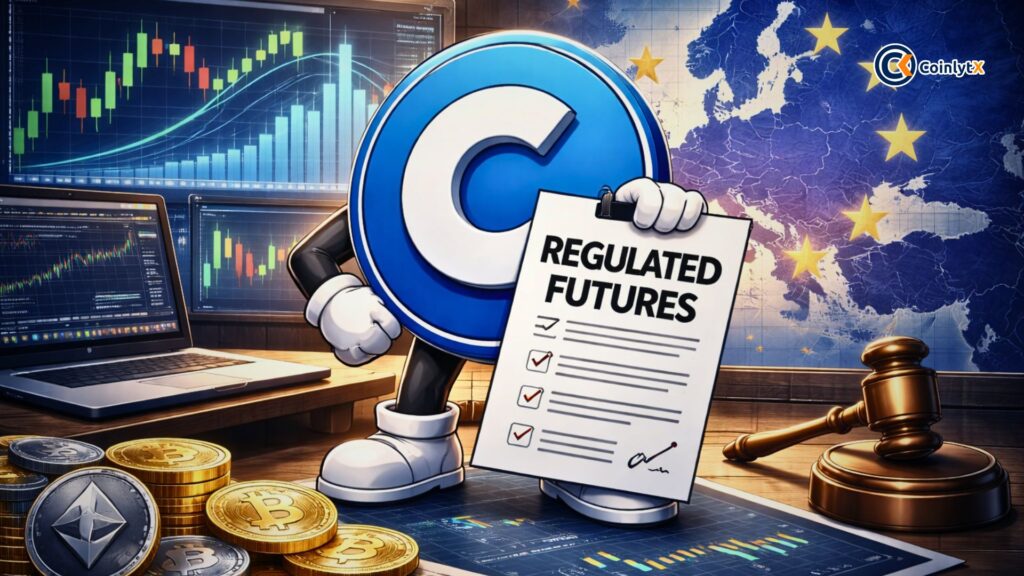
- Coinbase introduced regulated futures trading for Advanced users across 26 European markets under its MiFID entity.
- Traders will access crypto futures, equity index futures, and perpetual-style contracts.
- The rollout will offer regulated alternatives to offshore derivatives platforms.
Coinbase has launched futures trading across 26 European countries, giving Advanced users access to regulated crypto and equity index contracts. Traders can use perpetual-style and dated futures with leverage, offering a secure alternative to unregulated derivatives platforms.
Coinbase Futures Trading Europe Opens Regulated Access
Coinbase Futures Trading Europe has launched for Advanced users across 26 European countries. The rollout introduces regulated crypto derivatives trading through the exchange’s MiFID-regulated entity.
The new service allows eligible users in markets including Germany, France, and the Netherlands to access futures contracts. These contracts cover digital assets and equity-related derivatives within the Coinbase Advanced platform.
European traders historically relied on offshore platforms for derivatives due to complex regulations. Coinbase’s rollout provides a regulated alternative within a familiar trading environment.
Users can trade futures linked to Bitcoin, Ethereum, and Solana, as the platform also offers equity index products alongside digital asset derivatives.
Traders must complete eligibility checks and identity verification before accessing derivatives trading. Funding is available through Euro deposits or USDC transfers within the platform.
The derivatives section is available through the Coinbase Advanced interface on web and mobile applications. Access is gradually expanding across supported European markets.
Futures Contracts and Trading Structure
Coinbase Futures Trading Europe offers two main types of cash-settled futures contracts. Each contract type follows a different settlement structure.
Perpetual-style futures represent long-dated contracts with expiries extending up to five years. These contracts maintain price alignment through an hourly funding mechanism.
Settlement for perpetual-style contracts occurs once per day based on the platform’s calculation methodology. The structure resembles perpetual futures commonly used in crypto derivatives markets.
Dated futures contracts follow a traditional expiration model with monthly or quarterly settlement periods. These contracts are marked to market daily using official settlement prices.
If traders hold dated contracts until expiry, they are cash-settled automatically. This approach removes the need for physical asset delivery during settlement.
The platform also introduces equity-index futures alongside cryptocurrency contracts. These include the Mag7 + Crypto Equity Index Futures product.
The index combines exposure to major technology equities and cryptocurrency
exchange-traded funds. Coinbase launched the index earlier within its derivatives product expansion.
Leverage, Fees, and Coinbase Expansion Strategy
Coinbase Futures Trading Europe allows leverage depending on the contract type. Major products such as Bitcoin and Ethereum futures offer leverage up to 10x.
Other contracts provide leverage levels ranging between 4x and 5x. These limits apply to certain crypto and equity-based derivatives products.
Trading costs begin at 0.02% per contract, according to Coinbase’s announcement. The exchange states that the pricing aims to increase derivatives accessibility for European traders.
The derivatives rollout reflects Coinbase’s broader effort to expand its trading infrastructure. The company described the launch as part of its goal to become an “everything exchange.”
The strategy aims to integrate multiple asset classes into a single platform. Coinbase plans to expand beyond cryptocurrencies as regulatory frameworks develop across global markets.
European derivatives access follows several recent product expansions from the exchange. Earlier in 2026, Coinbase introduced prediction market trading for users in the United States.
The company indicated that additional derivatives and financial products may follow. Further launches will depend on regulatory clarity across Europe and other regions.