

Quick Takeaways
- Iran cannot locate all the sea mines it placed in the Strait of Hormuz, making the route unsafe for ships.
- This uncertainty is weakening its plan to charge tanker tolls in Bitcoin.
- Upcoming US-Iran talks in Islamabad will play a key role in deciding whether the ceasefire holds.
Iran is having a problem in the Strait of Hormuz. Its own wartime plan is now making it hard to talk and think about money.
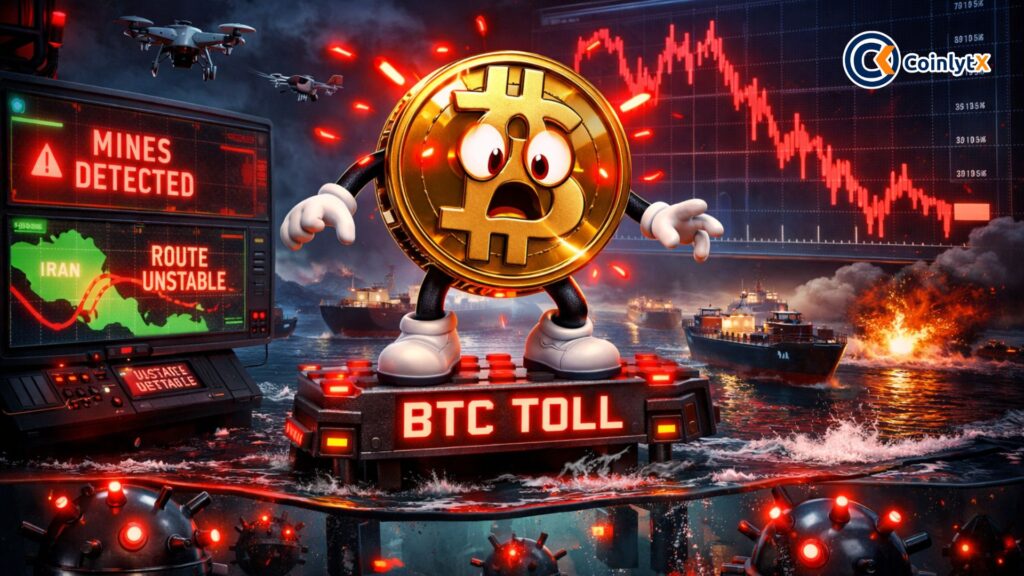
Officials say Iran does not know where all the sea mines are that it put there during the fighting. This makes it very risky for ships to go through and makes Iran less powerful.
The problem also affects Iran’s plan to charge ships in Bitcoin when they go through the Strait. The plan was to make money from ships going through while getting around the sanctions.
Now nobody is sure what will happen in the waterway,y and that makes people worried about safety and how much money Iran will make. The Strait of Hormuz problems are bad for Iran’s safety and its money.
Untracked Sea Mines Create Strategic Challenge
The Strait of Hormuz remains one of the world’s most critical oil chokepoints. Iran deployed sea mines using small boats after recent military strikes.
However, many of these mines were not properly tracked. Some may have drifted due to currents, increasing unpredictability.
US officials believe Iran lacks precise data on mine locations. This makes clearance operations extremely difficult.
Iran’s Foreign Minister Abbas Araghchi acknowledged “technical limitations” in reopening the route. This statement reflects deeper operational challenges.
Without accurate mapping, even Iran cannot guarantee safe passage. This undermines its ability to control the strait effectively.
Bitcoin Toll System Faces Real-World Constraints
Iran recently introduced a Bitcoin-based toll system for oil tankers. Ships must submit cargo details and pay fees in Bitcoin.
The system charges $1 per barrel, potentially reaching $2 million per tanker. It aims to bypass sanctions and generate significant revenue.
At full capacity, the model could produce billions annually. Estimates suggest up to $7.3 billion based on pre-war traffic levels.
However, the mine problem makes these projections uncertain. Tankers cannot safely transit if the route remains hazardous.
Shipping firms require clear safety assurances before entering the strait. Without them, participation in the toll system will remain limited.
The situation highlights a key flaw in the strategy. Financial innovation cannot replace physical security in global trade routes.
Ceasefire Talks Begin Under Mounting Pressure
Ceasefire talks have. Everyone is watching. Senior people from the United States and Iran are meeting in Islamabad. The goal of these talks is to find a way to make a ceasefire that will last.
The United States team is led by Vice President JD Vance. Other important people like Steve Witkoff and Jared Kushner are also there. Iran’s team has officials like Araghchi and leaders from their parliament.
Both the United States and Iran are under a lot of pressure to find a solution that works. The United States wants to make sure the strait can be opened again safely. President Donald Trump has said this is very important.
The problem is that neither the United States nor Iran has the ability to clear mines quickly. This means it will take me to find a solution. The talks need to figure out how to deal with logistical issues. If they do not come up with a plan, the ceasefire may not work.
Ceasefire talks are crucial for the United States and Iran to find peace. The United States and Iran need to work to make the ceasefire successful.
Economic Impact Extends Beyond Oil Markets
The disruption in the Strait of Hormuz affects more than oil flows. It also impacts how goods move around the world for products.
Industries like fertilizers and aluminum need stable shipping routes to work properly. When there are delays and uncertainty, it costs sectors more.
Higher oil prices also add to inflation. This affects markets, including cryptocurrencies like Bitcoin.
Bitcoin often changes value based on economic uncertainty. While problems in the world can make people want Bitcoin more, much instability can also slow its growth.
Iran’s situation shows how real-world problems can affect how people think about assets. The connection between world politics and cryptocurrency keeps getting stronger.
What Comes Next for Iran and Global Markets
The result of the talks in Islamabad will affect what happens to the Strait of Hormuz soon. If the talks are successful, things might get a little better for now. Iran and the Strait of Hormuz will be okay for a while.
However, learning from the area is a problem. If this problem is not solved, it is unlikely that the Strait of Hormuz will be fully open again.
The Bitcoin system in Iran needs the Strait of Hormuz to be safe so that boats can travel through it without any problems. Until that happens, the Bitcoin system in Iran will not make as much money as it could.
For people who buy and sell things around the world, the situation with the Strait of Hormuz is still changing. The price of oil, the way things are traded, and what people think about Bitcoin will all be affected by what happens.
This situation shows us something. When countries take actions with their military, it can have unexpected effects on the economy.
While people are still talking about the Strait of Hormuz, the whole world will be watching to see what happens. The Strait of Hormuz is an important place for global trade and for people to use Bitcoin.