


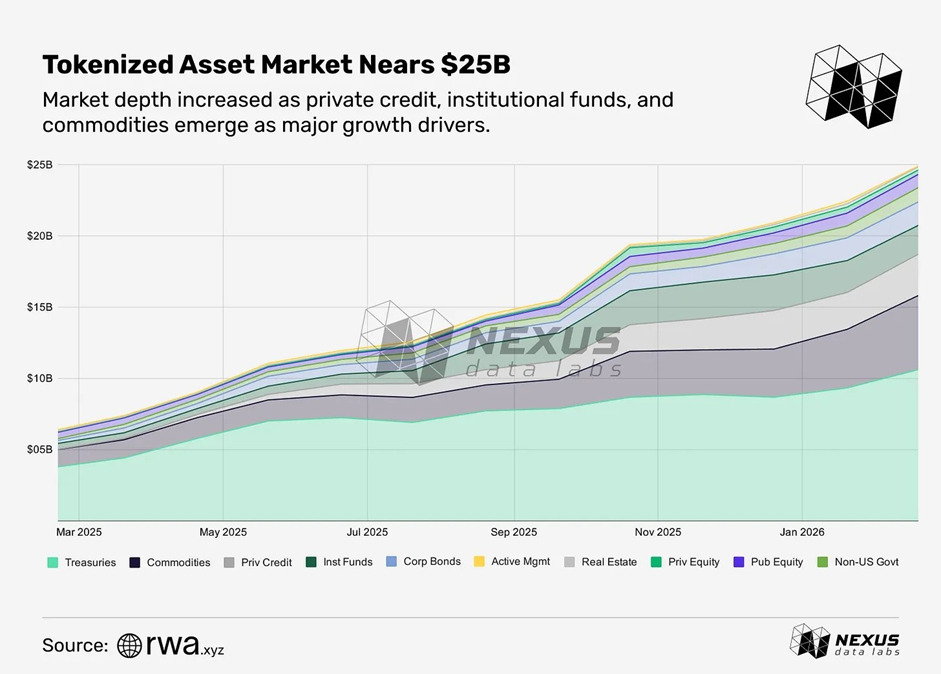
- The tokenized RWA market expanded to $24.9B, marking a 289% yearly increase.
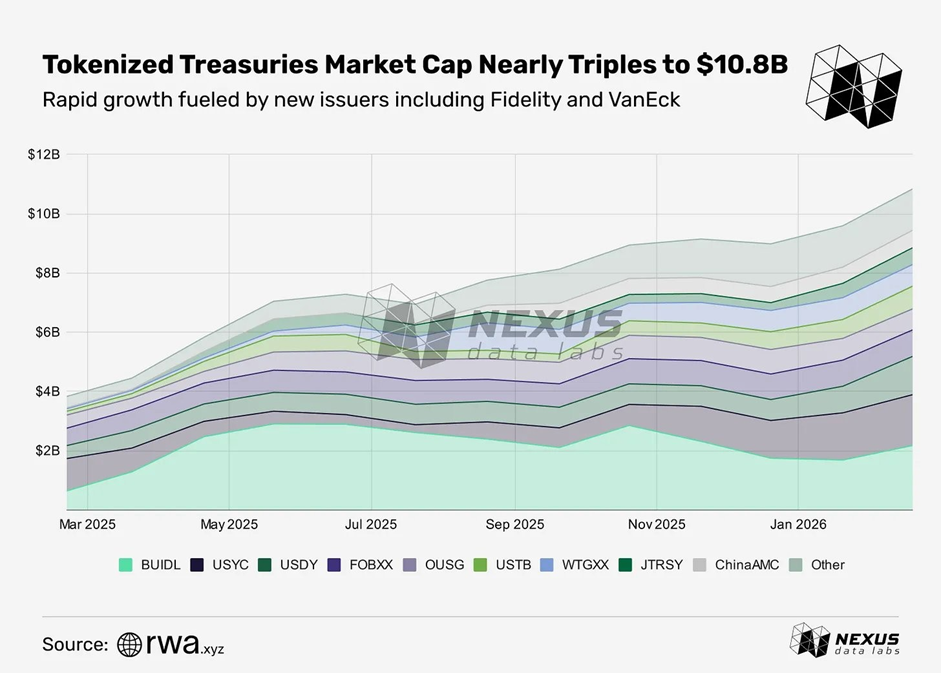
- Tokenized U.S. Treasuries reached about $10.8B as institutional asset managers entered the on-chain fixed-income market.
- Only 11.8% of RWA-backed stablecoins are used in DeFi.
Tokenized RWA Market cap is $25 billion. Treasuries, commodities, and stablecoin activity show the ongoing shift in on-chain activity.
Tokenized RWA Market Expands as Institutional Capital Enters
The Tokenized RWA Market reached about $24.9 billion on February 19, according to data compiled by Nexus Data Labs.
Data sourced from RWA.xyz shows the sector added roughly $18.5 billion during the past year. This represents about 289% growth across tokenized assets excluding stablecoins.
U.S. Treasuries and commodities accounted for about 58% of the market expansion. Institutions increasingly prefer blockchain rails to distribute conservative yield-generating assets
Source: X
Tokenized Treasury products offer on-chain settlement, transparent yield data, and continuous market access. These characteristics make them attractive during volatile crypto cycles.
However, the market composition is shifting. Treasuries once held 59% of tokenized assets but now represent about 43% of the total market.
Other asset classes, including private credit and corporate bonds, are gaining representation in the Tokenized RWA Market.
Tokenized Treasuries and Equities Attract New On-Chain Demand
Tokenized U.S. Treasuries expanded to about $10.8 billion over the past year. The chart shows the market nearly tripled during this period.
Source: X
Major asset managers have entered the segment with blockchain-based Treasury funds. These include products launched by Fidelity Investments and VanEck.
Their participation broadened the issuer landscape and improved institutional credibility for on-chain fixed-income products.
Several tokenized Treasury instruments now dominate the market. Products such as BUIDL, USDY, OUSG, and USTB continue gaining adoption among investors.
Demand remains steady despite short-term fluctuations observed during mid-2025. Investors appear to value stable yields combined with blockchain settlement speed.
Another chart tracks the growth of tokenized equities. The tokenized stock market capitalization climbed to about $786 million. Investors are exploring blockchain access to traditional equity exposure.
Tokenized equities allow fractional ownership and global accessibility. They also enable trading beyond traditional market hours.
Tokenized Gold and Stablecoins Reveal DeFi Liquidity Gap
Tokenized gold approached $5,000 per ounce, a 80% increase over the same period.
Supply growth appeared in step-like patterns across the chart. Continuous trading and transparent supply tracking contribute to this demand.
Another chart examines RWA-backed stablecoin activity within decentralized finance protocols. Data from DeFiLlama indicates that only about $1 billion of supply operates in DeFi markets.
This figure equals about 11.8% of the total RWA stablecoin supply. Most liquidity, therefore, remains outside decentralized applications.
The deployed portion is concentrated in several dominant assets. DAI accounts for roughly 40% of the DeFi share within this segment.
DAI’s position reflects the influence of MakerDAO, which integrated tokenized Treasuries into its collateral system.
Other assets include USDTb with about 25% and emerging tokens such as reUSD and USDAI.
Meanwhile, Ondo Finance issued USDY, which holds a notable share of the broader RWA stablecoin market. The distribution indicates growing experimentation with real-world asset collateral across decentralized finance ecosystems.