
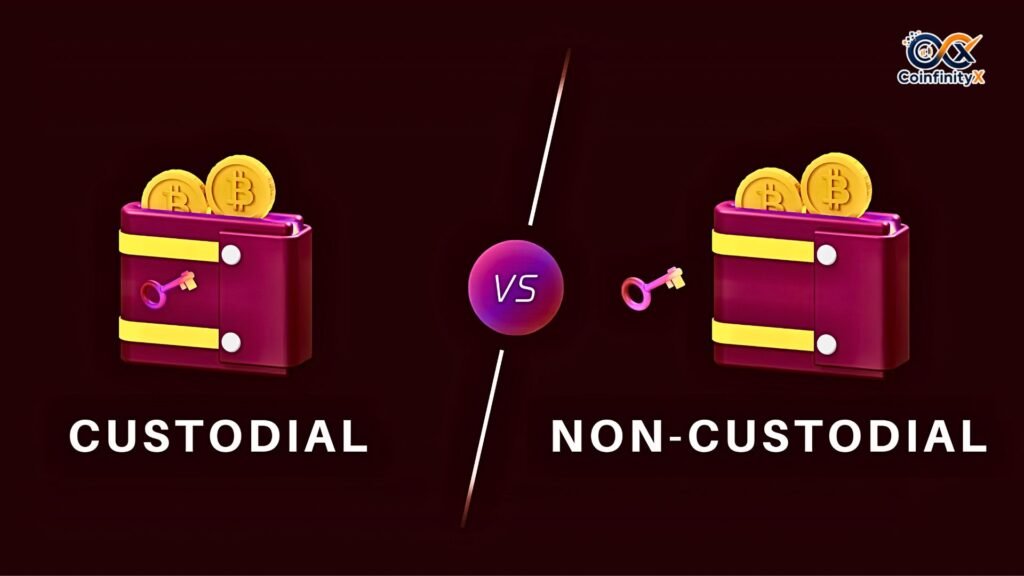
Custodial vs. Non-Custodial Wallets Explained
Key Insights
01
A cryptocurrency wallet is the gateway to blockchain-based digital assets.
02
Despite the name, a crypto wallet does not physically store coins or tokens.
03
Instead, it manages the private keys needed to prove ownership of assets associated with a particular blockchain address.
A cryptocurrency wallet is the gateway to blockchain-based digital assets. Despite the name, a crypto wallet does not physically store coins or tokens. Instead, it manages the private keys needed to prove ownership of assets associated with a particular blockchain address. The way those private keys are controlled creates two major wallet categories: custodial and non-custodial wallets.
The distinction is simple: with a custodial wallet, the private keys will be managed by a third party, and with a non-custodial wallet, the private keys will be managed by the user. These differences impact the security, privacy, recovery, convenience, and user experience of blockchain networks.
Custodial vs. Non-Custodial Wallets
| Feature | Custodial Wallets | Non-Custodial Wallets |
| Private key control | Third-party provider | User |
| Security responsibility | Mainly provider | Mainly user |
| Recovery | Password/support-based recovery may be available | Recovery phrase is generally required |
| Ease of use | Beginner-friendly | Requires more responsibility |
| Transactions | Often faster within the provider’s ecosystem | Depends on the blockchain |
| Regulatory oversight | Generally more subject to regulation | Generally less dependent on a custodian |
| KYC | Common with centralized providers | Wallet creation generally does not require KYC |
| dApp access | May be limited | Broad access to Web3 applications |
| Main risk | Custodian failure or restrictions | Key loss, scams, or user error |
| Control | Relies on the provider | Full user control |
Finally, it’s between control and convenience. Custodial wallets offer an easy way to manage cryptos, as the provider handles the security and recovery. Non-custodial wallets offer more autonomy, but they’re up to each user to keep safe.
What is a Custodial wallet?
Also known as a third-party wallet, a custodial wallet is one that stores and controls the private keys for a user.
If you’re a novice, it can be akin to using online banking. The user registers, sets a password, activates 2FA and logs in via an app or website to access their crypto. The provider takes care of the underlying private-key management.
Once a user requests a transaction, the provider signs and sends the transaction to the blockchain using the keys that it holds.
An outstanding benefit is account recovery. Custodial platforms can offer password reset, identity verification or customer support in case the users forgot their passwords. This can make it appealing to individuals that are not comfortable handling recovery phrases.
Security for assets can be further provided by custodians through the use of security measures, including cold storage, encryption, access control and multisignature authorisation.
The convenience comes with trust, however. The provider may apply withdrawal caps, block transfers, request identification or ban accounts as a result of regulations or investigations. In the event of a significant security breach, a financial failure or extended outage at the custodian, users may find it difficult to gain access to their assets.
What Is a Non-Custodial Wallet?
In a non-custodial wallet, users have full control of their private keys. The user is not relying on an exchange or financial service anymore, but handles the credentials that are needed to facilitate transactions.
Users will usually be given a 12 or 24-word Secret Recovery Phrase (or seed phrase) when they create a non-custodial wallet. This phrase can be used to re-derive private keys of the wallet.
The basic idea is that the one who has the private keys has the assets. Non-custodial wallets are particularly popular among people who use decentralized finance (DeFi), decentralized exchanges, NFTs, and other Web3 applications. Instead of putting resources with a central stage, clients can link their wallet straight to a decentralized application and concur exchanges on their own.
This gives a lot of freedom. A non-custodial wallet does not usually have a company behind it that would be able to do so based on their policies. Users are able to communicate with the supported blockchain networks without needing to obtain permission from a central authority.
The alternative to the trade-off is responsibility. There is no option to reset the password, as such. If a user loses their recovery phrase and has no valid backup, access to the wallet may be permanently lost.
Software and Hardware Non-Custodial Wallets
There are different types of non-custodial wallets such as software wallets or hardware wallets.
Software wallets come in the form of mobile apps, desktop software, or browser extensions.
They’re quick and easy, and they enable users to interact with blockchain applications rapidly. They, however, are exposed to malware, phishing attacks, malicious extensions and other cyber security threats since they are running on internet connected devices.
Hardware wallets, on the other hand, are physical wallets that store private keys in a more secure setting. They can also offer an extra level of security by isolating critical functions from the standard operating system of a cell phone or computer.
What is important is that both are not “custodial” when the user keeps the keys with himself.
Security & Privacy: Custodial vs. Non-Custodial
The way in which security works is different under the two models.
The custodial wallet partner is responsible for safeguarding the large sums of client funds. This can give high-tech security equipment but it also gives them a point target to attack. In many cases, all the customers are affected by a breach, operational failure, insolvency or regulatory action all in one.
The threat is more personal with a non-custodial wallet. Users are not exposed to the failure of a central custodian, except that they have to take care of their devices, private keys and recovery phrases.
There can also be varying levels of privacy. Account registration and Know Your Customer (KYC) checks are typically requirements for custodial services and may also be mandated by the service and/or jurisdiction. This can link a user together with their cryptocurrency pursuits.
Typically non-custodial wallets can be set up without the establishment of a regular financial account. This doesn’t mean that blockchain transactions are completely anonymous, however. Many networks have transaction activity and addresses that remain public.
Usability and Recovery
Usability problems with the two models are most obvious when things go wrong.
Customer support, password recovery, and account-management systems are all features that offer a level of security and peace of mind for users. This makes them appealing to new customers and those who are accustomed to the financial-app user experience.
Non-custodial wallets need more attention. It is the responsibility of the users to check addresses, networks, transaction fees and smart-contract access. If a transaction receives the wrong amount or an approval is made to an untrustworthy contract, it may be irrevocable.
Meanwhile, the new self-custody solutions are becoming more and more robust with recovery options and security features. These can help alleviate some of the common challenges that come with private key management, while still maintaining user control.
Can You Use Both Wallet Types?
Yes. This does not mean that users need to only select one model.
An active trader in the cryptocurrency market may have several funds in an online wallet to keep trading easily and move the more long-term holdings to a hardware wallet.
The same custodial structures may be utilized for various reasons in the case of businesses and institutions. Liquidity and operational transactions would benefit from a custodial solution, and self-custody can be advantageous for strategic reserves.
This combination of the two methods acknowledges that convenience and ownership don’t necessarily require each other to be mutually exclusive.
Which wallet is the best?
For customers who appreciate customer support and recovery, businesses, active traders, and beginners might consider using a custodial wallet. It can help ease the burden of managing private keys, but comes with the risk of trusting the provider.
For long-term investors, DeFi enthusiasts, Web3 users, and those seeking full control of their assets, a non-custodial wallet might be the superior choice. It provides more independence, but leaves the user to secure and recover the data.
Both models are not necessarily safe in all situations. It is dependent on your comfort level with self-custody, frequency of transactions, which applications you use, and how much control you wish to have.
Conclusion
The key difference between a custodial wallet and a non-custodial wallet is who is controlling the private key. The primary benefit of custodial wallets is that they are convenient, safe, and supported, whereas the point of non-custodial wallets is autonomy and direct ownership.
The important point for users to consider is not just about which wallet is better, but what is the best balance of control, convenience, security and responsibility for them.
| Feature | Custodial Wallets | Non-Custodial Wallets |
| Private key control | Third-party provider | User |
| Security responsibility | Mainly provider | Mainly user |
| Recovery | Password/support-based recovery may be available | Recovery phrase is generally required |
| Ease of use | Beginner-friendly | Requires more responsibility |
| Transactions | Often faster within the provider’s ecosystem | Depends on the blockchain |
| Regulatory oversight | Generally more subject to regulation | Generally less dependent on a custodian |
| KYC | Common with centralized providers | Wallet creation generally does not require KYC |
| dApp access | May be limited | Broad access to Web3 applications |
| Main risk | Custodian failure or restrictions | Key loss, scams, or user error |
| Control | Relies on the provider | Full user control |